Wednesday, October 23, 2013

Mechanism and Selectivity in Nickel-Catalyzed Cross-Electrophile Coupling of Aryl Halides with Alkyl Halides

by Soumik Biswas and Daniel J. Weix*


Abstract Image


The direct cross-coupling of two different electrophiles, such as an aryl halide with an alkyl halide, offers many advantages over conventional cross-coupling methods that require a carbon nucleophile. Despite its promise as a versatile synthetic strategy, a limited understanding of the mechanism and origin of cross selectivity has hindered progress in reaction development and design. Herein, we shed light on the mechanism for the nickel-catalyzed cross-electrophile coupling of aryl halides with alkyl halides and demonstrate that the selectivity arises from an unusual catalytic cycle that combines both polar and radical steps to form the new C–C bond.

Journal of the American Chemical Society

Article first published online: 18 AUG 2013

Transfer of Chirality in the Rhodium-Catalyzed Intramolecular [5+2] Cycloaddition of 3-Acyloxy-1,4-enynes (ACEs) and Alkynes: Synthesis of Enantioenriched Bicyclo[5.3.0]decatrienes

by Xing-zhong Shu, Casi M. Schienebeck, Wangze Song, Ilia A. Guzei, Weiping Tang*


Thumbnail image of graphical abstract


Chiral bicycles: Enantioenriched bicyclo[5.3.0]decatrienes were prepared from readily available chiral 3-acyloxy-1,4-enynes (ACEs) for the first time. In most cases, the chirality of the ACEs could be transferred to the bicyclic products with high efficiency. Inversion of the configuration was observed, thus confirming the predictions of previous computational studies.

Angewandte Chemie International Edition
Article first published online: 21 OCT 2013


Axially Chiral Dicarboxylic Acid Catalyzed Activation of Quinone Imine Ketals: Enantioselective Arylation of Enecarbamates

by Takuya Hashimoto, Hiroki Nakatsu, Yuka Takiguchi and Keiji Maruoka


Abstract Image


The synthetic utility of quinone imine ketals in the context of asymmetric catalysis was disclosed for the first time. By expanding the utility of chiral Brønsted acid catalysis to the electrophilic activation of quinone imine ketals, we succeeded in the development of highly enantioselective arylation of encarbamates to give α-amino-β-aryl ethers wherein quinone imine ketals act as functionalized aromatic ring surrogate. Further transformations of the products were also examined to establish procedures to provide chiral β-aryl amines and α-aryl esters.

Journal of the American Chemical Society
Article first published online: 22 OCT 2013

Hydrogenation of Carboxylic Acids Catalyzed by Half-Sandwich Complexes of Iridium and Rhodium


by Timothy P. Brewster, Alexander J. M. Miller *, D. Michael Heinekey , Karen I. Goldberg*


Abstract Image

A series of half-sandwich Ir and Rh compounds are demonstrated to be competent catalysts for the hydrogenation of carboxylic acids under relatively mild conditions. Of the structurally diverse group of catalysts tested for activity, a Cp*Ir complex supported by an electron-releasing 2,2′-bipyridine ligand was the most active. Higher activity was achieved with employment of Brønsted or Lewis acid promoters. Mechanistic studies suggest a possible reaction pathway involving activated carboxylic acid substrates. The hydrogenation reaction was shown to be general to a variety of aliphatic acids.

Journal of the American Chemical Society
Article first published online: 21 OCT 2013


Asymmetric Palladium(II)-Catalyzed Cascade Reaction Giving Quaternary Amino Succinimides by 1,4-Addition and a Nef-Type Reaction

by Manuel Weber, Wolfgang Frey, René Peters*


Thumbnail image of graphical abstract


Simple starting materials, high-value products: A dinuclear ferrocene-based PdII complex transforms mixtures of racemic N-benzoyl α-amino acids, nitroolefins, acetic anhydride, and manganese acetate into biologically interesting quaternary aminosuccinimides. The products are obtained as single diastereomers in enantioenriched form. Key steps of the cascade mechanism are a 1,4-addition of in situ generated azlactones to nitroolefins and a Nef-type reaction.

Angewandte Chemie International Edition
Article first published online: 21 OCT 2013


Catalytic Enantioselective Synthesis of Functionalized Tropanes Reveals Novel Inhibitors of Hedgehog Signaling

by Rishikesh Narayan, Jonathan O. Bauer, Carsten Strohmann, Andrey P. Antonchick*, Herbert Waldmann*


Thumbnail image of graphical abstract


Dipolar cycloaddition: A highly efficient copper(I)-catalyzed enantioselective [3+2] cycloaddition reaction of 1,3-fused cyclic azomethine ylides and nitroalkenes has been developed. This method provides access to functionalized tropane scaffolds with several quaternary and tertiary stereocenters in a single step under mild reaction conditions.

Angewandte Chemie International Edition
Article first published online: 21 OCT 2013

A Streamlined Strategy for Aglycone Assembly and Glycosylation

by Katherine M. Partridge, Scott J. Bader, Zachary A. Buchan, Christopher E. Taylor, John Montgomery*


Thumbnail image of graphical abstract

Multipurpose sugars: Carbohydrate-derived silane reagents are utilized as the reductant for nickel-catalyzed aldehyde–alkyne reductive coupling reactions and as the glycosyl donor for subsequent intramolecular glycosylation. The approach enables the assembly of the carbon–carbon framework and stereochemical features of an aglycone while simultaneously establishing the site of glycosylation.

Angewandte Chemie International Edition
Article first published online: 21 OCT 2013

Profound Methyl Effects in Drug Discovery and a Call for New CH Methylation Reactions


by Heike Schönherr, Tim Cernak*


The methyl group is one of the most commonly occurring carbon fragments in small-molecule drugs. This simplest alkyl fragment appears in more than 67 % of the top-selling drugs of 2011 and can modulate both the biological and physical properties of a molecule. This Review focuses on so-called magic methyl effects on binding potency, where the seemingly mundane change of C-H to C-Me improves the IC50 value of a drug candidate more than 100-fold. This discussion is followed by a survey of recent advances in synthetic chemistry that allow the direct methylation of C(sp2)-H and C(sp3)-H bonds. It is our hope that the relevance of the meager methyl group to drug discovery as presented herein will inspire reports on new C-H methylation reactions.


Thumbnail image of graphical abstract


It′s a kind of magic: The methyl group is one of the most prominent functional groups in bioactive small molecules and appears in more than 67 % of the top-selling drugs. This Review highlights examples of the magic methyl effect, whereby the installation of a single methyl group boosts potency by more than two orders of magnitude. New C-H activation reactions are required to facilitate the direct introduction of methyl groups.

Angewandte Chemie International Edition
Article first published online: 22 OCT 2013

Synergistic Effect of Ketone and Hydroperoxide in Brønsted Acid Catalyzed Oxidative Coupling Reactions

by Bertrand Schweitzer-Chaput, Abhishek Sud, Áron Pintér, Stefanie Dehn, Philipp Schulze, Martin Klussmann*


Thumbnail image of graphical abstract


Waste not wasted: A mechanistic study of the autoxidative coupling of xanthene with cyclopentanone uncovered an autoinductive effect of the waste product hydrogen peroxide. It generates radicals in the presence of acid and ketones, which accelerate the reaction by providing an additional pathway to the reactive hydroperoxide intermediate. This discovery could be applied to achieve other Brønsted acid-catalyzed oxidative coupling reactions.

Angewandte Chemie International Edition
Article first published online: 22 OCT 2013

Tuesday, October 22, 2013

One-pot three-component sulfone synthesis exploiting palladium-catalysed aryl halide aminosulfonylation

by Charlotte S. Richards-Taylor, David C. Blakemore, Michael C. Willis*


A palladium-catalysed aminosulfonylation process is used as the key-step in a one-pot, three-component sulfone synthesis. The process combines aryl-, heteroaryl- and alkenyl iodides with a sulfonyl unit and an electrophilic coupling fragment. The sulfonyl unit is delivered in the form of an aminosulfonamide, which then serves as a masked sulfinate. The sulfinate is combined,in situ, with an electrophilic coupling partner, such as a benzylic, allylic or alkyl halide, an electron-poor arene, or a cyclic epoxide, to provide the corresponding sulfone products in good to excellent yields. The mild reaction conditions and use of commercially available reaction components allows the easy preparation of a broad range of sulfones featuring a variety of functional groups. The process obviates the need to employ thiol starting materials, and oxidative operations.

Chemical Science
DOI: 10.1039/C3SC52332B

How much do van der Waals dispersion forces contribute to molecular recognition in solution?

by Lixu Yang, Catherine Adam, Gary S. Nichol & Scott L. Cockroft*


Attractive van der Waals dispersion forces have been implicated in mechanisms as diverse as gecko adhesion and anaesthesia. Now, it has been found using synthetic molecular balances that dispersion forces between alkyl chains are an order of magnitude weaker in solution than they are in the gas phase.

Nature Chemistry
DOI: 10.1038/nchem.1779

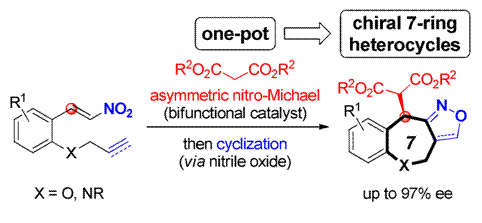
Highly Enantioselective Synthesis of Chiral 7-Ring O- and N-Heterocycles by a One-pot Nitro-Michael/Cyclization Tandem Reaction

by Renate Rohlmann, Constantin Gabriel Daniliuc, Olga Garcia Mancheno*

A concise enantioselective approach to medium-sized 7-ring O- and N-heterocycles has been developed. The synthetic strategy relies on an organocatalytic nitro-Michael/nitrile oxide cycloaddition tandem reaction, leading to the corresponding chiral benzoxe- and benzazepine derivatives containing an additional fused dihydroisoxazoline ring in good yields and excellent enantioselectivities (up to 97% ee).

Chemical Communications


Synthesis of a,b-Unsaturated Carbonyl Compounds via a Visible-Light -Promoted Organocatalytic Aerobic Oxidation

by Zhen Yang, Junling Zhang, Leming Wang, Qi Liu, Yong Huang*


a,b-Unsaturated ketones and aldehydes have been synthesized from the corresponding silyl enol ethers in a straightforward protocol involving a visible-light promoted organocatalytic, aerobic oxidation reaction. A cheap organic dye was used in catalytically in the reaction as the photosensitizer.

Chemical Communications
DOI: 10.1039/C3CC46778C

Synthesis of 3-((trifluoromethyl)thio)indoles via a reaction of 2-alkynylaniline with trifluoromethanesulfanylamide

by Jie Sheng, Shaoyu Li, Jie Wu


3-((Trifluoromethyl)thio)indoles can be accessed through a palladium(II)-catalyzed reaction of 2-alkynylaniline with trifluoromethanesulfanylamide in the presence of bismuth(III) chloride. The presence of bismuth(III) chloride is crucial for the success of this transformation, which would activate the trifluoromethanesulfanylamide during the process.

Chemical Communications
DOI: 10.1039/C3CC45958F

Enantioselective synthesis of 1,2,4-triazolines catalyzed by a cinchona alkaloid-derived organocatalyst

by Qian Shao, Jiean Chen, Meihua Tu, David W. Piotrowski, Yong Huang


An enantioselective organocatalytic process for the one-step synthesis of poly-substituted 1,2,4-triazolines is reported. The heterocycle formation is believed to go through a step-wise mechanism of nucleophilic addition of an azlactone to an azodicarboxylate in the presence of an organic base catalyst, followed by a TMSCHN2 mediated heterocyclization. Both theoretical calculations and experimental evidence suggest the pre-organization of the transition state for the chirality determining step via a unique 7-membered intramolecular hydrogen bonding.

Chemical Communications
DOI:10.1039/C3CC46757K

Copper nanoparticle-catalyzed cross-coupling of alkyl halides with Grignard reagents

by Ju Hyun Kim and Young Keun Chung*

Graphical abstract: Copper nanoparticle-catalyzed cross-coupling of alkyl halides with Grignard reagents


A cross-coupling reaction between alkyl bromides and chlorides and various Grignard reagents was carried out in the presence of commercially available copper or copper oxide nanoparticles as a catalyst and an alkyne additive. The catalytic system shows high activity, a broad scope, and good functional group tolerance.

Chemical Communications
DOI: 10.1039/C3CC46419A

Monday, October 21, 2013

Synthesis of Enantioenriched Tertiary Boronic Esters by the Lithiation/Borylation of Secondary Alkyl Benzoates

by Alexander P. Pulis, Daniel J. Blair, Eva Torres and Varinder K. Aggarwal*

TOC Graphic


Simple, secondary 2,4,6-triisopropyl benzoates (TIB esters) and secondary dialkyl N,N-diisopropyl carbamates have been reported to be resistant to deprotonation by strong bases. We have found that the combination of sBuLi (1.6 equiv) and TMEDA (6 equiv) in CPME at −60 °C enables deprotonation of unactivated secondary dialkyl TIB esters, but not the carbamates. These carbanions were reacted with a range of neopentyl boronic esters which, after 1,2-metalate rearrangement and oxidation, gave a range of tertiary alcohols in high yield and universally high er. Further functional group transformations of the tertiary boronic esters were demonstrated (conversion to quaternary centers, C-tertiary amines) together with application of the methodology to the synthesis of the simplest unbranched hydrocarbon bearing a quaternary center, (R)-4-ethyl-4-methyloctane, validating the synthetic utility of the methodology.


Journal of the American Chemical Society

Thiophosphoramide-Based Cooperative Catalysts for Brønsted Acid Promoted Ionic Diels–Alder Reactions

by Alina Borovika, Pui-In Tang, Seth Klapman, Pavel Nagorny*

Thumbnail image of graphical abstract


Three's a crowd: The combination of a Brønsted acid and a hydrogen-bond donor cocatalyst was found to promote various ionic [2+4] cycloadditions under mild reaction conditions (see scheme; Ts=4-toluenesulfonyl). Thiophosphoramides are the most effective cocatalysts because of the stronger counterion activation effect resulting from three, rather than two, hydrogen bonds involved in anion binding.


Angewandte Chemie International Edition

Halogen and Chalcogen Cation Pools Stabilized by DMSO. Versatile Reagents for Alkene Difunctionalization

by Yosuke Ashikari, Akihiro Shimizu, Toshiki Nokami and Jun-ichi Yoshida*

TOC Graphic


Halogen and chalcogen cations (X+ = Br+, I+, ArS+, and ArSe+) were generated by low-temperature electrochemical oxidation in the presence of dimethyl sulfoxide (DMSO) and were accumulated in the solution. DFT calculations indicated that DMSO stabilizes these cations by coordination. The complexes of I+ with one and two DMSO molecules were observed by cold-spray-ionization MS analyses. The stability of the resulting cation pools of X+ increased in the order of Br+ < I+ < ArS+ < ArSe+, which could be explained in terms of the electronegativity of X. The cation pools served as versatile reagents for organic synthesis; the reactions with alkenes gave β-X-substituted alkoxysulfonium ions, which were converted to the corresponding carbonyl compounds by the treatment with triethylamine, whereas the treatment with methanol gave the corresponding alcohols. The reactions with aminoalkenes and 1,6-dienes gave the cyclized products.


Journal of the American Chemical Society

Squaramide-Catalyzed Enantioselective Michael Addition of Masked Acyl Cyanides to Substituted Enones

by Kin S. Yang, Antoinette E. Nibbs, Yunus E. Türkmen and Viresh H. Rawal*

TOC Graphic


Masked acyl cyanide (MAC) reagents are shown to be effective umpolung synthons for enantioselective Michael addition to substituted enones. The reactions are catalyzed by chiral squaramides and afford adducts in high yields (90–99%) and with excellent enantioselectivities (85–98%). The addition products are unmasked to produce dicyanohydrins that, upon treatment with a variety of nucleophiles, provide γ-keto acids, esters, and amides. The use of this umpolung synthon has enabled, in enantiomerically enriched form, the first total synthesis of the prenylated phenol (+)-fornicin C.


Journal of the American Chemical Society